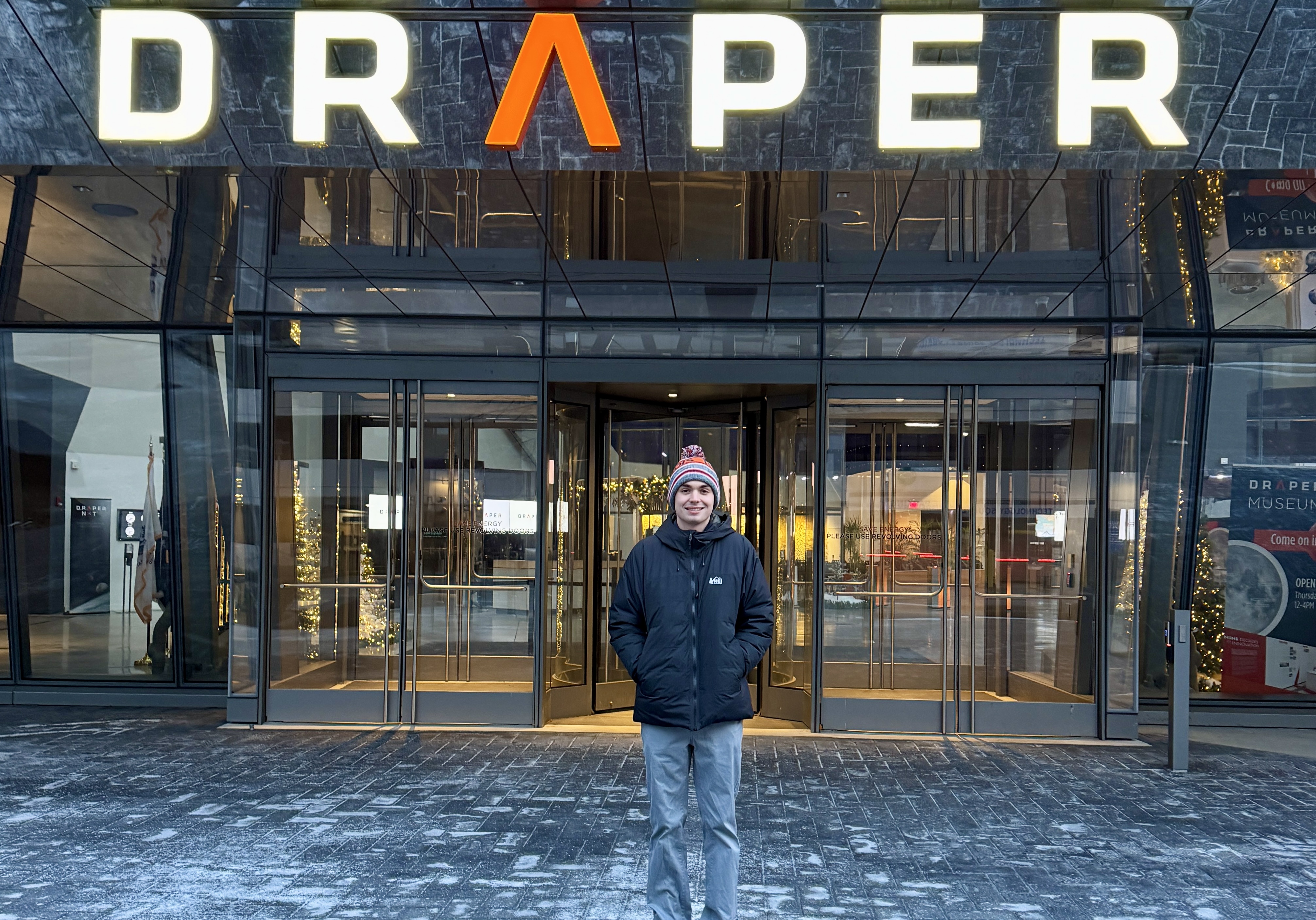
Draper • Cambridge, MA • January – June 2026
Six months as a guidance, navigation, and control engineer at Draper, split across three projects. Due to the nature of this work, this page is intentionally vague.
Draper is a non-profit engineering R&D lab that has been doing guidance and navigation since Apollo. I worked as a GNC engineer/researcher during my 6 months as a co-op.
The bulk of my time went to the GNC design for a vehicle that was both underactuated and undersensed: fewer control authorities than degrees of freedom to command, and less direct state measurements than ideal.
I created and validated control schemes for the vehicle, including non-linear flight regimes. Most of the design effort was spent on the trade between response time and maneuverability, refined iteratively using simulations and numerical solvers.
I built Monte Carlo sweeps to characterize the vehicle across its perturbations and unknowns: atmospheric and environmental variation, initial condition dispersions, actuator and sensor error, and uncertainty in the vehicle model itself. With limited sensing, it is important to understand the limits of the filters, and that threshold is most visible in a large Monte Carlo set.
The sweeps served the requirements work as well. Sweeping a parameter across a dispersed run set shows both what the vehicle tolerates and where performance falls off.
Those results fed system-level GNC requirements, with each component in the loop getting its own: the filters, the sensors, the guidance, and the controller. Every requirement traced back to the simulation evidence that produced it.
Another project I worked on was trajectory generation. Framed purely as an optimization problem: search a space of candidate trajectories for one that satisfies the vehicle's constraints while minimizing a cost.
The software drives its physics-based propagator with a stochastic, population-based optimizer. Candidates are scored against the objective, the better performers are recombined and perturbed, and the population converges on global optima.
My contribution was developing the trajectories for a new vehicle. I set the control schemes, the flight plan, and the objectives. I also generated and reviewed the resulting trajectory sets, checking outputs for constraint violations and non-physical artifacts before they were used downstream.
The output fed early developmental work on new programs and software for a new vehicle. These trajectory studies were run before an architecture was settled, so the results were used to bound what was achievable and to inform the tools and vehicle concepts being built around them.
Alongside the vehicle work I contributed to Draper's in-house 6-DOF GNC framework in Simulink.
The goal was modularity: vehicle dynamics, actuator models, and sensor suites as swappable blocks, so setting up a new vehicle becomes a configuration with components that are easy to change. I implemented pieces of each of those three layers.
I followed software development best practices throughout. I worked on feature branches, opened merge requests for review, responded to reviewer feedback, and documented my changes. The framework will be deployed across multiple air and space vehicle programs at Draper.